No Upper Age Limit for Nursing Programs: A Game-Changer for Aspiring Nurses in India

Key Takeaways
- 1Indian Nursing Council (INC) has officially declared the elimination of any maximum or upper age limit for admission to various nursing programs in India.
- 2This momentous decision is poised to revolutionize the landscape of nursing education in the country, making it more inclusive and accessible to individuals of all ages and backgrounds.
- 3The INC’s recent […].
Listen to this Article
Narrated by system voice
Indian Nursing Council (INC) has officially declared the elimination of any maximum or upper age limit for admission to various nursing programs in India. This momentous decision is poised to revolutionize the landscape of nursing education in the country, making it more inclusive and accessible to individuals of all ages and backgrounds.
The INC's recent announcement signals a significant stride forward for the nursing profession in India. It dismantles a long-standing barrier that restricted individuals from pursuing their passion for nursing based on age, thereby promoting a more diverse and multigenerational nursing workforce.
This move carries substantial implications for those individuals who, in their earlier years, may not have had the opportunity to embark on a nursing career. For older adults, this change represents a second chance to fulfill their lifelong dream of becoming a nurse. It is a testament to the INC's commitment to fostering a nursing community that is representative of the nation's demographics.
Moreover, the INC's decision aligns with the emerging needs of India's healthcare system. As the population ages, the demand for skilled nurses is set to surge. By abolishing age restrictions, the INC is not only welcoming a broader pool of applicants but also contributing to ensuring a sustainable supply of nursing professionals who can cater to the healthcare needs of India's diverse population.
This shift in policy opens doors for aspiring nurses, regardless of their age, to enroll in programs such as Auxiliary Nurse Midwifery (ANM), General Nursing and Midwifery (GNM), Bachelor of Science in Nursing (B.Sc.(N)), Master of Science in Nursing (M.Sc.(N)), Post Basic B.Sc. Nursing (PBB.Sc.(N)), Post Basic Diploma, and Nurse Practitioner courses. This inclusive approach recognizes that the desire to serve as a nurse can spark at any age, and educational opportunities should not be bound by arbitrary age limits.
Nurses and nursing students across India have welcomed this decision with open arms. It sends a powerful message that the nursing profession is, indeed, open to all, irrespective of one's chronological age. Aspiring nurses, whether they are fresh out of school or seasoned professionals seeking a career change, can now pursue their passion without the hindrance of age-related restrictions.
The Indian Nursing Council's abolition of the upper age limit for nursing programs is a transformative step that acknowledges the aspirations and potential of individuals across generations. It paves the way for a more diverse and skilled nursing workforce, poised to meet the evolving healthcare needs of India. This progressive move ensures that there is no such thing as being "too old" to embark on the noble journey of nursing, and it reaffirms the profession's commitment to serving society at large.
This decision by the Indian Nursing Council is indeed a beacon of hope, illuminating the path for countless individuals who have longed to answer the calling of nursing, regardless of their age.
Get the brief that 12,000+ nurses read every Tuesday
Top stories. INC updates. CNE opportunities. 5-minute read.
Double opt-in via Brevo. Unsubscribe anytime.
Read our Editorial Policy · Corrections Policy · Fact-Checking Policy
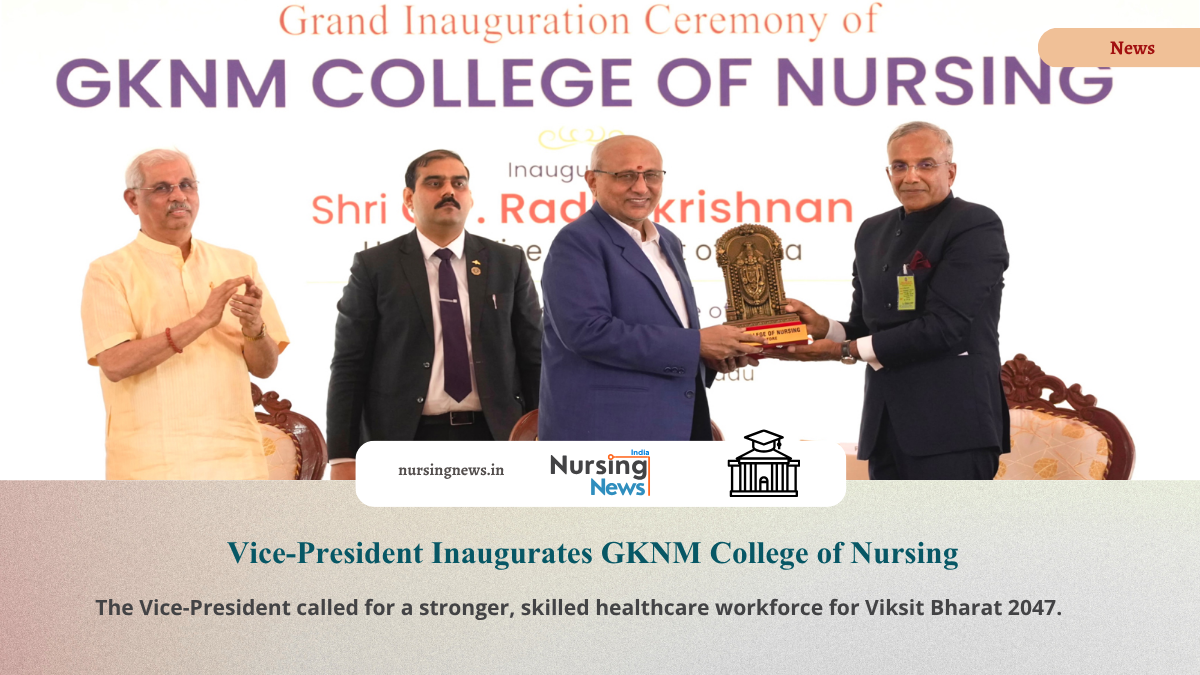
Vice-President opens GKNM College of Nursing, calls for a stronger health workforce
At the Coimbatore inauguration, C. P. Radhakrishnan called nurses central to healing and tied nursing education to India's Viksit Bharat 2047 goal.
2 min read