

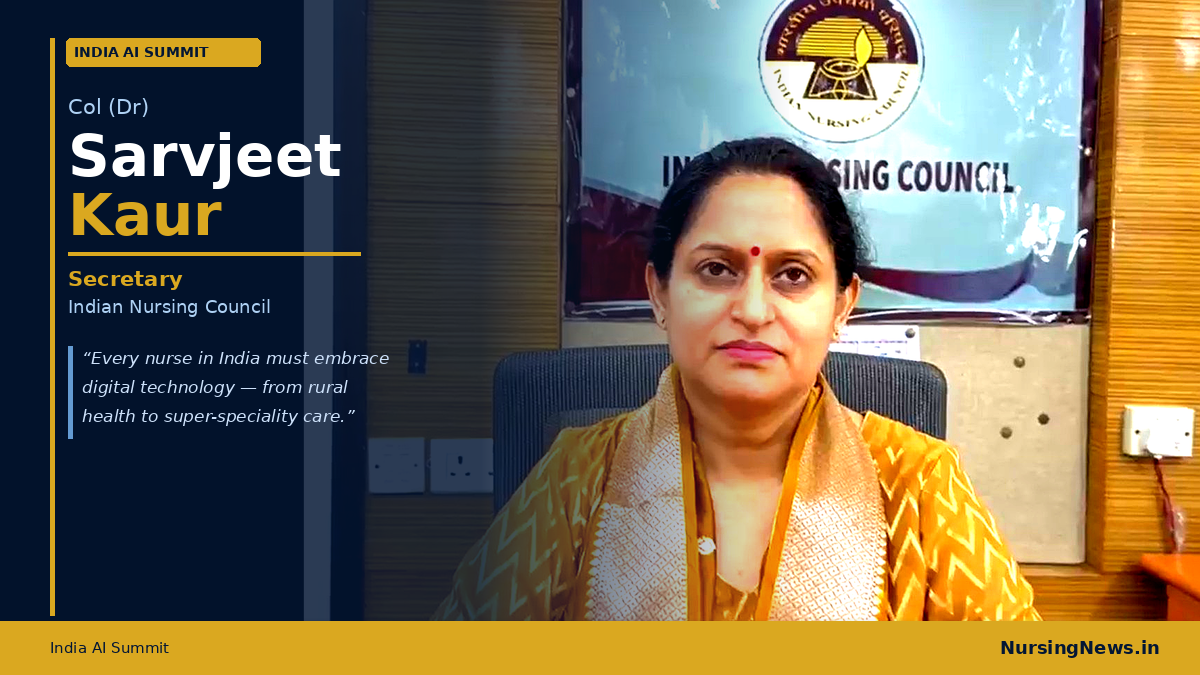
At the India AI Summit, Col (Dr) Sarvjeet Kaur, Secretary of the Indian Nursing Council (INC), made a compelling case for placing digital literacy and artificial intelligence at the heart of nursing education and professional development in India. Speaking on behalf of over 2.2 million registered nurses — and potentially 3 million when all registrations are accounted for — she outlined the steps her organisation is taking to prepare the nursing workforce for a technology-driven future.
A Curriculum Built for the Digital Age
Col (Dr) Kaur pointed to a landmark shift in nursing education: the BSc Nursing curriculum was revised in 2021 to embed digital health and AI as core competencies, not optional add-ons. “From a regulatory perspective, AI and digital health have been integrated into the basic nursing curriculum,” she noted.
As part of this update, five simulation labs are now mandatory in nursing institutions. The INC has provided detailed guidance on the necessary equipment — including mannequins and virtual reality tools — to ensure that students develop hands-on competencies even as access to traditional clinical training facilities becomes increasingly limited. With approximately 250,000 nursing students graduating and registering as nurses and midwives each year, the scale of this reform is substantial.
Building Faculty Capacity Through National Simulation Centres
Recognising that expensive simulation equipment is of little use without trained educators, the INC established two national reference simulation centres — one in Gorakhpur and another recently opened in South India. Around 2,000 faculty members have already been trained at the Gorakhpur centre on how to effectively use simulators in classroom and clinical settings.
“The goal is for every nursing student to embrace digital technology to build their competencies,” Col (Dr) Kaur said. The INC has also established basic computer education standards — including a minimum ratio of one computer for every five students — and set up computer labs across affiliated institutions.
Reaching the 4 Million Already in Service
Perhaps the bigger challenge lies not with students, but with the millions of nurses already working across India’s hospitals, community health centres, and rural facilities. Col (Dr) Kaur acknowledged that curriculum changes are slow — typically occurring once a decade, with the BSc nursing revision alone taking three years to complete.
To bridge this gap, the INC has taken a targeted approach. A six-month professional digital nursing course has been introduced and linked to Continuing Nursing Education (CNE) hours, creating a strong incentive for practising nurses to participate. Crucially, the INC has tied 150 CNE hours to the mandatory renewal of nursing registration every five years — ensuring a steady stream of participants for digital upskilling programmes.
Free platforms such as INC and iGOT have been made available to nurses seeking to complete these courses, removing cost as a barrier. The INC is also working towards a one- to two-year specialised programme in partnership with the Digital Health Academy to further deepen knowledge and widen participation.
A Simulation Centre in Every District
Looking ahead, Col (Dr) Kaur described an ambitious vision: simulation centres in every district across the country, so that nurses — whether working in rural primary care or super-speciality hospitals — have accessible, hands-on opportunities to upgrade their skills. These centres would be integrated into the CNE framework, ensuring that training is not a one-off event but a continuous professional obligation.
Every Nurse, Every Setting
Drawing on global trends, Col (Dr) Kaur highlighted the emergence of “chief technical nurses” in other countries — senior nursing leaders who leverage data and digital tools to resolve critical issues such as staffing shortages, patient safety, and policy design. She stressed that India needs to nurture similar leadership at every level of the system, not just in urban tertiary hospitals.
Her message at the India AI Summit was clear: the digital transformation of healthcare cannot succeed if nurses — the largest segment of the health workforce — are left behind. With the right infrastructure, incentives, and institutional will, India’s 4 million nurses can be a powerful force in delivering technology-enabled care to every corner of the country.
Details: Col (Dr) Sarvjeet Kaur is the Secretary of the Indian Nursing Council (INC), which oversees the registration and education standards of over 4 million nurses across India






 Sarvjeet Kaur outlines India's plan to equip 4 million nurses with digital and AI skills, speaking at the India AI Summit.)