
There are moments in policy history that quietly shift the direction of an entire system. The launch of SAHI and BODH at the India AI Impact Summit 2026 may well be one of them.
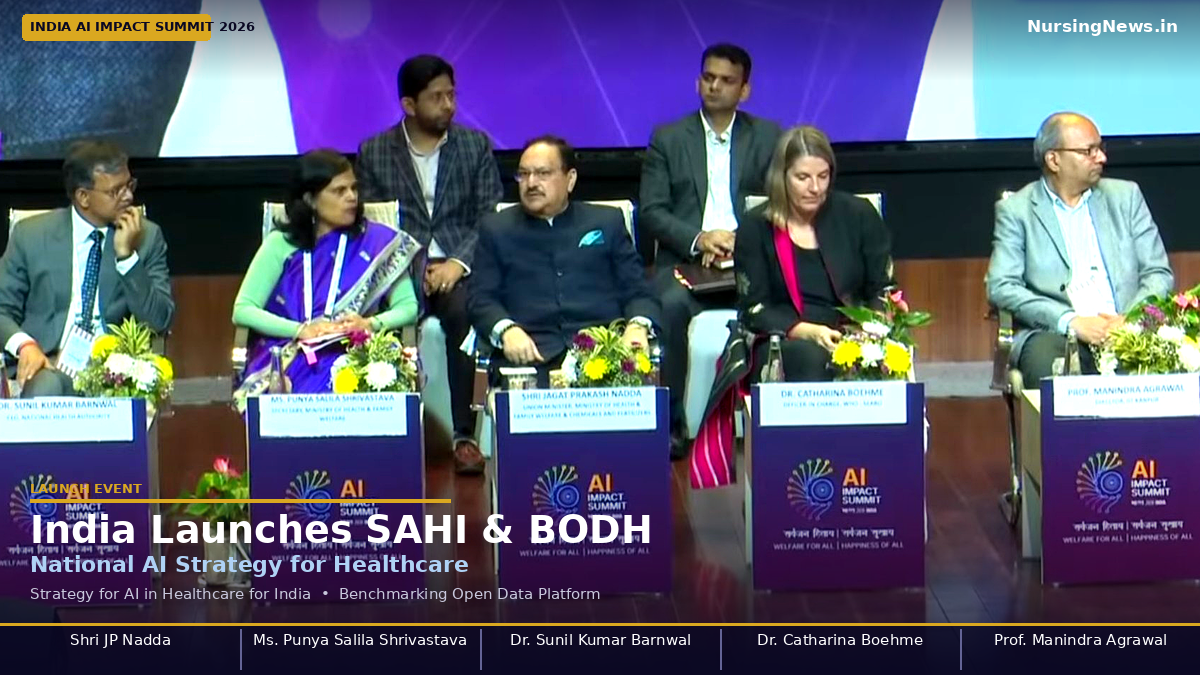
Union Minister for Health and Family Welfare Shri Jagat Prakash Nadda formally launched two pioneering digital health initiatives — SAHI (Strategy for Artificial Intelligence in Healthcare for India) and BODH (Benchmarking Open Data Platform for Health AI) — at the India AI Impact Summit 2026. The room brought together a rare convergence of minds: senior government officials, technologists, global health leaders and clinical experts, all gathered around a shared conviction that India’s AI moment in health has arrived — and that this time, it must be done right.
Setting the Stage
Shri Kiran Gupalaska, Joint Secretary and Mission Director of the Ayushman Bharat Digital Mission, opened the event with a framing that set the tone for everything that followed. Electricity reshaped societies. So did the internet. Artificial intelligence, he argued, is the next such general-purpose technology — one that will touch diagnosis, treatment, hospital management, public health surveillance and policy decisions. But history rewards not those who build the most sophisticated tools, but those who implement them effectively, at scale, and with responsibility. The real measure of success, he said, will not be the best model in a laboratory — it will be the most trusted, safe and impactful system deployed across districts, states and communities.
It was a grounding note. And it ran through every address that followed.
The Strategy India Needed
India already has a national AI strategy. But Dr. Sunil Kumar Bandwal, CEO of the National Health Authority and the man who chaired the committee that drafted SAHI, explained why healthcare needed its own. While national AI initiatives provide horizontal capabilities and enabling infrastructure, they do not sufficiently guide how healthcare AI efforts should be channelled towards national health priorities. Healthcare carries unique sensitivities — patient safety, ethics, data privacy, clinical accountability — that a sector-agnostic strategy simply cannot address. The goal was never to slow AI down. It was to build the guardrails within which it could move confidently, at scale, without causing harm.
Shri Nadda described SAHI as not merely a technology strategy but a governance framework, a policy compass, and a national roadmap for the responsible use of AI in healthcare — one that will guide India in leveraging AI in a manner that is ethical, transparent, accountable, and people-centric.
The SAHI strategy document contains 32 specific recommendations across five pillars. These cover governance, regulation and trust; health data and digital infrastructure; workforce and institutional capacity; research, innovation and evidence generation; and ecosystem development for population-scale AI deployment. Key recommendations include classifying AI healthcare solutions by risk level and regulating them accordingly, ensuring AI training data reflects the population and settings where the tool will operate, and establishing accountability rules to determine liability for harm caused by AI systems.
What makes SAHI credible is how it was built. Four major workshops — in Vijayawada, Delhi, Shillong and at IIT Bombay — brought together clinicians, health technology companies, state governments, regulators, civil society and development partners. SAHI provides a structured framework for collaboration, ensuring that innovation flourishes while public interest remains paramount.
The Platform That Builds Trust
If SAHI is the strategy, BODH is the accountability mechanism. BODH, developed by IIT Kanpur in collaboration with the National Health Authority, is a privacy-preserving benchmarking platform that enables rigorous evaluation of AI models using diverse, real-world health data without sharing underlying datasets. As a digital public good under the Ayushman Bharat Digital Mission, it has been designed to strengthen trust, transparency and quality assurance in health AI deployment.
BODH uses federated learning technology — instead of moving sensitive patient data to a central server, the AI model travels to where the data is stored, learns from it, and returns without ever seeing or extracting personal details, complying with the DPDP Act 2023.
Professor Manindra Agrawal, Director of IIT Kanpur, put the case for BODH simply: almost every AI solution provider claims 98% or 99% efficacy — and third parties must evaluate these solutions to ensure they are safe for real-world use cases. Do you want to test an unproven solution on a real patient, or benchmark it first?
A Global Milestone, Rooted Locally
The international significance of the moment was not lost on Dr. Catharina Boehme, Officer-in-Charge of the WHO South-East Asia Regional Office. She noted that India is among the first countries to adopt a national AI strategy for health, setting an important global benchmark, and that the strategy has been designed to strengthen healthcare delivery, improve decision-making, and extend the reach of services to underserved populations.
The India AI Impact Summit 2026 has marked a transition from experimental AI pilots to a unified national framework — pivoting the conversation toward what some are calling “sovereign health intelligence.”
Health Secretary Puna Shrivastava, who delivered the keynote, brought the conversation back to ground. AI in India’s public health system is not a future ambition — it is already at work. The Cough Against TB (CATB) AI solution has already been used to screen over 160,000 people for lung tuberculosis. AI is also active in diabetic retinopathy screening, telemedicine consultations, outbreak surveillance and vulnerability mapping. Today’s launch, she said, is not the beginning of India’s AI health journey. It is the moment that journey gets a map.
What Comes Next
National AI strategies in low- and middle-income countries almost never launch with a complementary operational instrument — strategy documents and implementation platforms are typically separated by years, if the platform arrives at all. The concurrent release of SAHI and BODH represents an unusual attempt to close the strategy-to-implementation gap at the very moment of policy announcement.
For India’s health workforce — including its millions of nurses, doctors and community health volunteers — SAHI’s explicit pillar on workforce capacity and change management is perhaps its most consequential commitment. Medical and nursing curricula will need to be updated to train the next generation of healthcare professionals to work effectively with AI tools. Technology, every speaker agreed, is only as good as the people who use it and the systems that support them.
India has drawn its roadmap. The work of walking it now begins.